
How To
If your 🥑 avocado plant keeps struggling with yellow leaves or stunted growth, you’re probably not giving it how much light does an avocado plant need—and that’s completely fixable.
Most people assume these tropical trees need full sun, but avocado plants actually thrive with bright, indirect sunlight that mimics their natural habitat.
Here's the secret: while they love sunlight, direct rays can scorch delicate leaves, especially in hot climates. The ideal setup gives your avocado plant 6-8 hours of filtered light daily, whether through a south-facing window or a well-placed grow light.
Don't worry if you've had mixed results before—this guide will show you exactly how to adjust your plant's light exposure for healthier growth, whether you're growing indoors or outdoors. We'll cover everything from recognizing light stress to creating the perfect setup for your home.
The best part? With these simple adjustments, you'll see stronger stems, glossier leaves, and—if you're patient—even the potential for fruit. Let's get your avocado plant the light it truly craves for a thriving, vibrant plant.


Optimal light requirements for avocado plants: bright indirect sunlight explained
Avocado plants (Persea americana) are sun-worshippers that crave bright, indirect sunlight to thrive. Unlike many houseplants, they can't survive in dim corners—they need 6 to 8 hours of direct sunlight daily for optimal growth.
In their native tropical climates, young trees grow under dappled canopy light, while mature trees bask in full sun.
For indoor avocado plants, the ideal light intensity ranges between 10,000 to 15,000 lux. This is roughly equivalent to the light you'd find near a south-facing window on a clear day.
Without enough light, your plant will stretch toward the nearest source, producing long, weak stems and sparse foliage—a condition called etiolation.
Outdoor avocado trees (USDA Zones 9-11) thrive in full sun exposure, but young seedlings should be gradually acclimated to prevent sunburn. Start with 2-3 hours of morning sun, then increase exposure over 2-3 weeks to their final light destination.
This mimics their natural understory growth pattern in the wild.
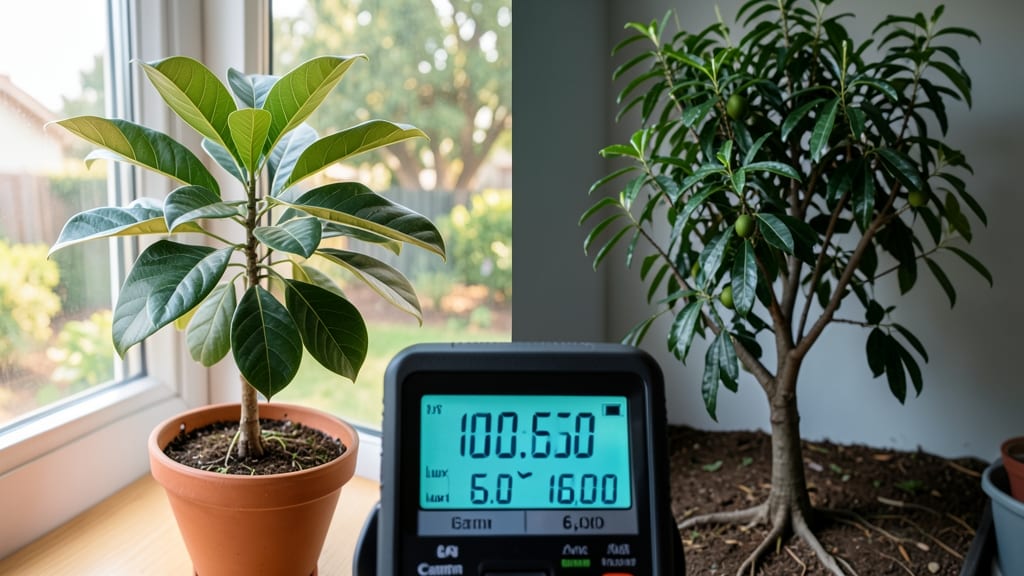
Here’s how to measure your plant’s light exposure at home: Use a light meter or smartphone app (like Light Meter or Lux Light Meter) to check lux levels near your plant.
If readings drop below 5,000 lux, it’s too dim. Above 20,000 lux? Your plant may be getting too much harsh sunlight.
| Growth Stage | Light Needs | Ideal Lux Range | Best Location |
|---|---|---|---|
| Seedling (0-6 months) | Bright indirect light | 5,000–10,000 lux | East/west window, under grow lights |
| Juvenile (6-24 months) | Partial sun (morning + afternoon) | 10,000–15,000 lux | South-facing window, patio with shade cloth |
| Mature (2+ years) | Full sun (6+ hours direct) | 15,000–25,000 lux | Outdoor garden, greenhouse, or bright sunroom |
Avocado leaves are highly efficient at photosynthesis when exposed to blue and red light spectrums (400–500nm and 600–700nm wavelengths). This is why they thrive under natural sunlight or full-spectrum LED grow lights.
If your plant’s leaves appear dark green and healthy, it’s getting the right light. But if they’re light green or yellowing, it’s a sign of light deficiency.
One common misconception is that avocado plants can thrive in low-light conditions like a north-facing window. While they’ll survive, they’ll grow slowly and weakly, with fewer leaves and no fruit production. For fruit-bearing trees, you’ll need to supplement with grow lights during winter months when daylight shortens.
Pro tip: Rotate your plant quarter-turns every 2-3 weeks to ensure even light exposure on all sides. This prevents one-sided growth and helps the plant develop a strong, balanced structure. Even outdoor avocado trees benefit from occasional rotation to avoid leaning toward the sun.
For indoor growers, south-facing windows are the gold standard, but west-facing windows can work too—just be prepared for hot afternoon sun that may require sheer curtains to diffuse the light. East-facing windows provide gentler morning light, which is ideal for seedlings but may not be enough for mature plants.
Remember, light quality matters more than quantity for avocado plants. They prefer natural sunlight over artificial light, but if you’re growing indoors year-round, invest in a full-spectrum LED grow light with a 12-hour photoperiod to mimic daylight cycles. This will keep your plant healthy and productive even in low-light spaces.
Signs your avocado plant has too much or too little light (with fixes)
Your avocado plant 🥑 communicates its light needs through subtle (and not-so-subtle) clues. Ignoring these signs often leads to stunted growth or leaf scorch—both completely avoidable with the right adjustments. The key is learning to read between the yellowing leaves and brown leaf edges.
When your plant gets too much direct sunlight, you’ll notice crispy, brown edges on leaves—almost like they’ve been sunburned. This happens because avocado leaves lack the protective wax coating of desert plants.
On the flip side, too little light causes leaves to turn pale yellow and stretch unnaturally toward any available light source (a condition called etiolation).
Here’s the good news: both issues are fixable with simple light adjustments. For sunburned leaves, move your plant to a spot with filtered sunlight or use a sheer curtain to diffuse harsh rays.
If your plant looks leggy and weak, it’s begging for more bright indirect light—whether from a south-facing window or a grow light.
✅ Too Little Light
- Pale yellow leaves (loss of chlorophyll)
- Leggy stems (stretching toward light)
- Slow growth (weak new leaves)
💡 Fix: Move to brighter spot or add grow light.
❌ Too Much Light
- Brown leaf edges (sunburn)
- Wilted leaves (overheating)
- Leaf drop (severe stress)
💧 Fix: Use sheer curtain or move to indirect light.
For indoor growers, the south-facing window is ideal because it provides the most consistent light throughout the day. However, if your window gets intense afternoon sun, place your avocado plant a few feet back from the glass to avoid leaf scorch.
Rotate the pot every few weeks so all sides get even light exposure—this prevents lopsided growth and ensures your plant stays balanced.
Outdoor avocado plants also need gradual acclimation when transitioning between seasons. If you’re moving a potted plant from indoors to outdoors in spring, start with morning sun only and gradually increase exposure over 1-2 weeks.
This hardens the leaves and prevents shock from sudden light changes. The same rule applies when bringing them back indoors for winter—slowly reduce light exposure to mimic natural seasonal shifts.
Pro tip: Pay attention to your plant’s new growth. Healthy avocado leaves should be deep green, glossy, and about 3-5 inches long. If new leaves are smaller or lighter in color, it’s a clear sign your plant needs either more or less light.
Trust your observations—your avocado plant will thank you with stronger stems and potentially even fruit in a few years! 🌱